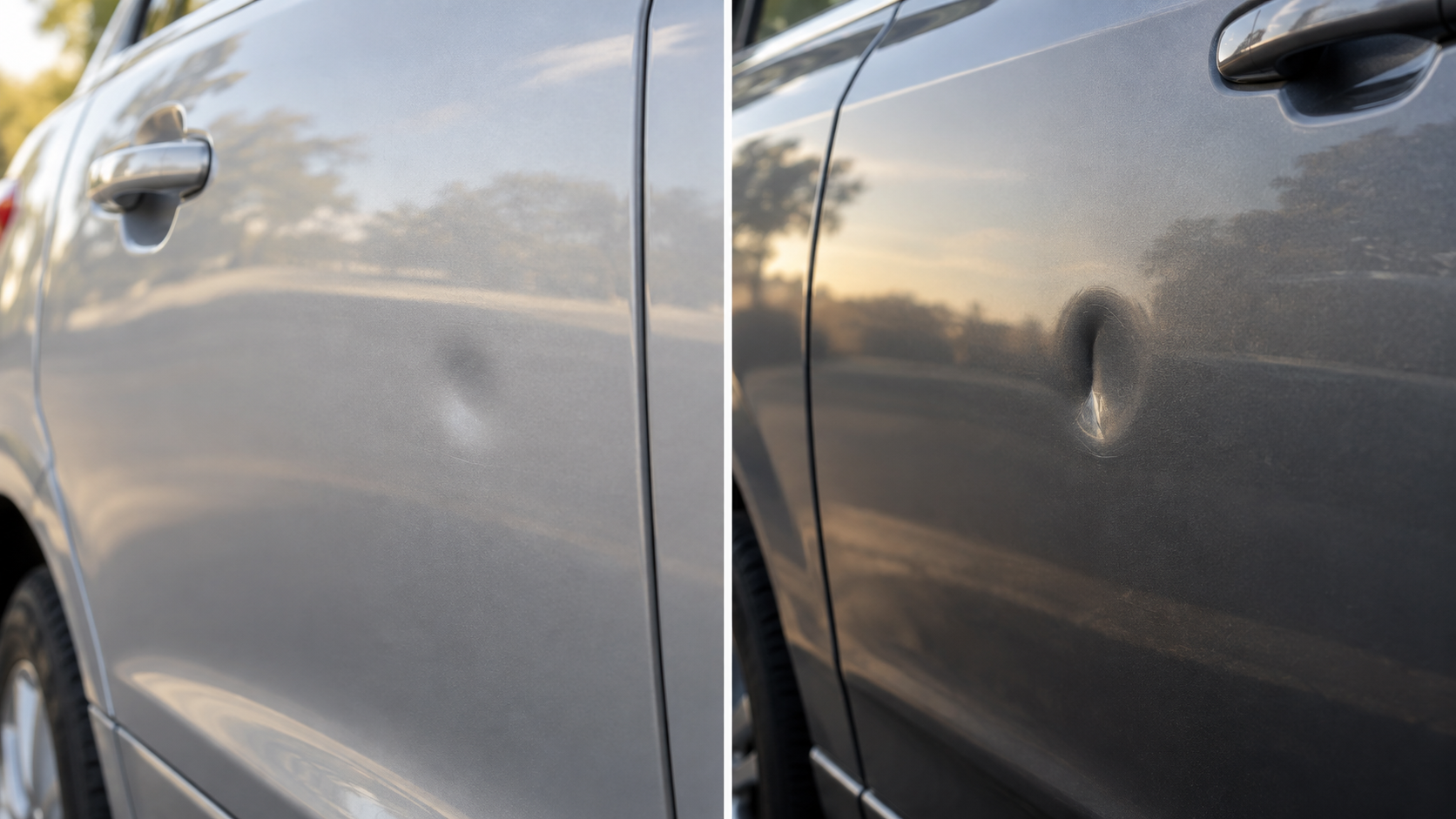
A door ding and a deeper dent may cover about the same surface area, but that doesn’t mean they require the same repair process. The shape, depth, impact angle, and metal condition can matter more than the damage’s overall diameter.
During a professional paintless dent repair assessment, the technician studies how the panel was affected rather than relying on size alone. Understanding these differences helps vehicle owners recognize why every dent must be evaluated individually.
What Is Typically Considered a Door Ding?
A door ding is generally a small, shallow indentation caused by a relatively minor impact. It often occurs when another vehicle’s door, a shopping cart, or a similar object makes contact with the side of a parked car.
Many door dings are rounded and leave the factory paint intact. These characteristics may make them good candidates for paintless dent repair. However, the location still matters. A ding over an internal brace, near a panel edge, or directly on a body line can be more complicated than one in an open area of a door.
Examples of different types of completed dent and ding repairs can help drivers understand how damage may vary from one panel to another.
What Makes a Dent “Deeper”?
A deeper dent is not defined by width alone. It has a more pronounced low point, which indicates that the impact pushed the metal farther inward. Depending on the force and angle of impact, the surrounding metal may also have shifted or stretched.
Rounded Dents
Rounded dents usually have gradual slopes leading toward the center. When the paint is undamaged and the metal has not been excessively stretched, the technician may be able to restore the contour by applying carefully controlled pressure.
Sharp Dents
Sharp dents have a concentrated point of impact. The force is focused within a smaller area, potentially creating a tight low spot or stressing the paint. These dents often require greater precision because the technician must gradually release the tension surrounding the deepest point.
Creased Damage
A crease forms when an object travels across the panel during impact rather than striking one isolated spot. This movement creates an elongated indentation that may include several pressure points. The crease’s length, sharpness, and location all affect repairability.
Why Stretched Metal Changes the Repair
Vehicle metal can flex during an impact, but it has limits. When an impact is forceful enough, the metal may stretch beyond its original dimensions. A stretched panel has more surface material than before the damage, making it harder to return the entire area to its factory contour.
Signs that may indicate more complex damage include:
- A very deep or sharply defined center
- Raised areas surrounding the dent
- Cracked, chipped, or separated paint
- Distortion across a body line or panel edge
- A large dent within a relatively small impact area
These signs do not automatically determine whether PDR is possible. They simply show why a hands-on evaluation is important. The paintless dent repair FAQ offers additional information about the damage that may be suitable for this process.
Impact Angle Also Affects Dent Shape
A straight-on impact may produce a relatively symmetrical dent. An object striking from the side can push the metal in more than one direction, creating an uneven low area, a crease, or tension elsewhere on the panel.
Specialized lighting allows the technician to study these subtle changes through reflected lines and shadows. Rather than pushing only on the visible center, the technician works gradually across the affected area to restore the panel’s natural contour.
Have Your Vehicle Dent Professionally Assessed
Whether your vehicle has a shallow door ding or more serious damage, its size alone will not reveal the complete repair picture. Consider shape, depth, paint condition, panel material, location, and accessibility.
Un-Dent Inc. provides professional mobile dent repair services throughout Port St. Lucie, Stuart, Martin County, and St. Lucie County. Explore more vehicle dent repair information or contact Un-Dent Inc. for a free estimate. Call or text 772-979-0468. Appointments are available Monday through Saturday from 8:00 a.m. to 8:00 p.m.