Why Choosing the Right Repair Method Matters
When dents, dings, or hail damage appear on your car, you have more than one option for repairs. While traditional body shops have long been the standard, mobile paintless dent repair (PDR) offers a modern alternative. Understanding the differences between these methods helps car owners make the best choice for their time, budget, and vehicle condition.
What Is Mobile Paintless Dent Repair?
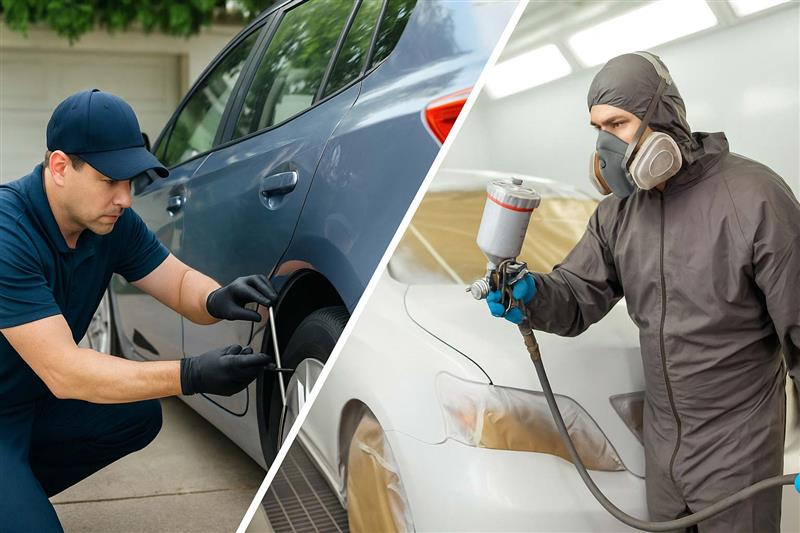
PDR is a specialized process that removes dents without sanding, filling, or repainting. Using tools designed to massage the metal back into place, technicians restore the panel to its original shape. Mobile PDR brings this service directly to your home or office, eliminating the need to leave your car at a shop.
Benefits of Mobile PDR
- Convenience: Technicians come to you, saving time.
- Preserves Original Paint: No sanding or repainting means your factory finish remains intact.
- Cost-Effective: Typically, less expensive than traditional repairs.
- Fast Turnaround: Many dents can be repaired in just a few hours.
- Eco-Friendly: No chemicals, fillers, or paint are used in the process.
Limitations of PDR
- Works best on small to medium dents.
- May not be suitable for sharp creases or damage where paint is cracked.
- Severe collisions usually require more extensive repair methods.
Traditional Body Shop Repairs
Traditional auto body shops use sanding, body fillers, and repainting to repair dents. This approach can restore vehicles after major accidents or when dents have damaged the paint.
Benefits of Body Shop Repairs
- Handles Severe Damage: Best for accidents, large dents, or structural issues.
- Paint Matching: Provides refinishing when the paint is scratched or chipped.
- Comprehensive Service: Can address frame damage and mechanical issues along with dents.
Drawbacks of Body Shop Repairs
- Time-Consuming: Repairs often take days or weeks.
- Higher Cost: Labor and materials make this method more expensive.
- Paint Variations: Even with blending, new paint may not perfectly match the factory finish.
- Less Convenient: Requires leaving your car at the shop, which may mean arranging alternative transportation.
Side-by-Side Comparison
| Feature | Mobile PDR | Traditional Body Shop |
| Best For | Small to medium dents, hail damage | Large dents, paint or frame damage |
| Time | Hours | Days to weeks |
| Cost | Generally lower | Higher due to labor and materials |
| Paint Preservation | Maintains original finish | Requires sanding, fillers, repaint |
| Convenience | Mobile service at your location | Must drop car at shop |
Which Repair Option Is Right for You?
- Choose Mobile PDR if: your dents are minor, the paint isn’t damaged, and convenience is a top priority.
- Choose Body Shop Repairs if: the dent is severe, the paint is cracked, or there’s collision-related damage.
Conclusion
Both mobile PDR and traditional body shop repairs have advantages, and the right choice depends on the type and severity of damage. For most everyday dents and dings, mobile PDR offers a faster, more cost-effective solution. For larger accidents or paint damage, traditional body shops remain the go-to option. To learn more about PDR and find out what repair method is best for your vehicle’s dent call Un-Dent’s office at 772-212-1445. Un-Dent is available in Martin and St. Lucie counties in Florida. Their website is https://undentinc.com.